 Montana Montana
Infectious
Medical Waste
Definition of Infectious Waste
Management of Infectious Medical Waste
OSHA Regulations
Statutes, Regulations and Guidelines
Contacts
Definition of Infectious Waste
An “infectious waste” means waste capable of producing
disease. Infectious waste includes but is not limited to:
- Cultures and stocks of infectious agents and associated
biologicals,
- Human pathological waste, including tissues, organs,
and body parts removed during surgery or an autopsy;
- Free-flowing waste human blood and products of blood,
including serum, plasma, and other blood components and items soaked
or saturated with blood; and
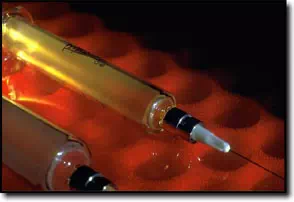
- Sharps that have been used in patient care, medical
research, or industrial laboratories.
Management of Infectious
Waste
The following rules apply to the storage, transportation
and treatment of infectious waste:
Segregation: Infectious waste must be separated
from ordinary waste at the point of origin and stored until the waste
is rendered noninfectious or transported off-site.
Packaging/containers. Infectious waste must
be stored in containers with biohazard warning labels. The following
rules apply:
- Sharps must be contained for storage, transportation,
treatment, and subsequent disposal in leakproof, rigid, puncture-resistant
containers that must be taped closed or capped securely to prevent
loss of contents.
- Infectious waste other than sharps must be contained
in moisture-proof disposable containers or bags of a strength sufficient
to prevent ripping, tearing, or bursting under normal conditions of
use. The bags must be securely tied to prevent leakage or expulsion
of solid or liquid wastes during storage, handling, and transportation.
Storage. To inhibit the spread of infectious
agents, infectious waste must be stored prior to treatment in a secured
area that prevents access by unauthorized personnel and must be clearly
marked or labeled as infectious.
Handling. Handling of infectious waste must
be done in a manner to prevent compaction or other mechanical manipulation
that might cause the release of infectious agents.
Treatment/disposal. Treatment and disposal
of infectious waste must be accomplished through the following methods:
- Incineration with complete combustion that reduces
infectious waste to carbonized or mineralized ash.
- Steam sterilization that renders infectious waste
noninfectious. Steam-sterilized waste must be labeled identifying
it as such with heat sensitive tape or bagged in marked autoclavable
bags.
- Sterilization by standard chemical techniques or
by any scientifically proven techniques approved by state and federal
authorities. Chemically treated waste or waste otherwise treated
must be appropriately labeled.
- Liquid or semisolid infectious waste may be discharged
into a sewer system that provides secondary treatment or into a primary
treatment sewage system if waste is first sterilized by chemical treatment.
A subsurface disposal system installed and operated in accordance with
state or local sanitary regulations is, for the purpose of this subsection
(b), a sewer system providing secondary treatment.
If infectious waste has been rendered noninfectious
by one of the methods listed, it is no longer biologically hazardous,
it may be mixed with and disposed of with ordinary waste in the following
manner:
- Infectious waste may be transported by the generator,
a municipal solid waste service, or a regulated commercial hauler to
an offsite treatment facility if the waste is confined in a leakproof,
noncompacting, fully enclosed vehicle compartment.
- Infectious waste that has been treated by one of
the methods in subsection (4) may be disposed of in a properly operated
and licensed landfill.
Training. An employee who handles or manages
infectious waste must receive training provided by the employer that
is adequate to ensure safe performance of duties.
Contingency plan. Generators and transporters
of infectious waste shall develop a contingency plan to handle spills
and equipment failure.
OSHA Regulations
In addition to the state medical waste environmental
regulations there are some Occupational Safety and Health Administration
(OSHA) rules that apply to medical/infectious waste. Montana is one
of 26 states covered entirely by the federal OSHA program. This program
is operated by the Occupational Safety and Health Administration. OSHA
rules (Occupational Exposure to Bloodborne Pathogens Standards) impact
various aspects of medical/infectious waste, including management of
sharps, requirements for containers that hold or store medical/infectious
waste, labeling of medical/infectious waste bags/containers, and employee
training. These requirements can be found in the HERC section entitled OSHA Standards for Regulated Waste.
Statutes, Regulations and
Guidelines
Montana Code
75-1—1005: Management Standards for Infectious Waste
Contacts
Montana Department of Environmental
Quality
More Information
None located.
|